Platform Engineering: Building Internal Developer Platforms with Backstage and Crossplane
How to build a self-service developer platform that reduces environment provisioning from weeks to minutes using Backstage, Crossplane, and ArgoCD
Platform Engineering has emerged as the answer to a critical question: how do you enable 200+ engineers to provision production-ready environments without creating a bottleneck on your infrastructure team? The answer is an Internal Developer Platform (IDP) that provides self-service infrastructure with built-in guardrails.
In this guide, I'll share how we built a platform that reduced environment provisioning from 2-3 weeks to under 10 minutes while maintaining SOC 2 compliance.
Why Platform Engineering?
The DevOps promise was "you build it, you run it." The reality? Most developers don't want to be infrastructure experts — they want to ship features. Platform Engineering bridges this gap by providing:
- Golden paths: Opinionated, pre-configured templates that encode best practices
- Self-service: Developers provision what they need without tickets
- Guardrails: Automated policy enforcement prevents misconfigurations
- Abstraction: Cloud complexity hidden behind simple, consistent APIs
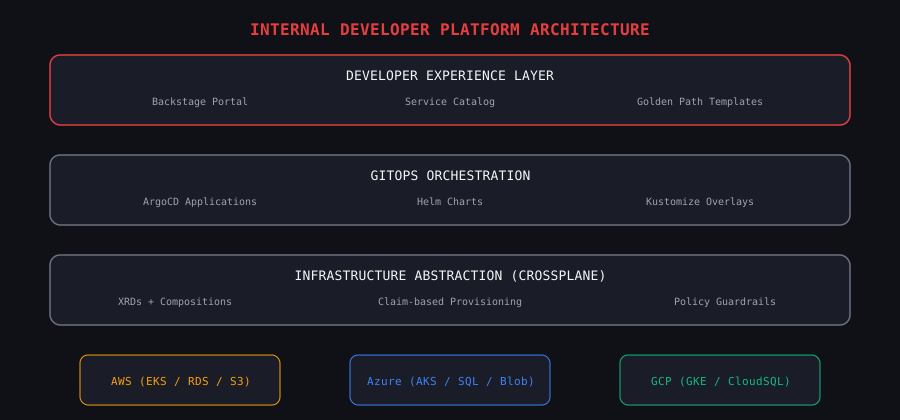
The Architecture: Three Layers
Layer 1: Developer Experience (Backstage)
Backstage is the frontend of your platform. It provides a unified portal where developers can:
- Discover existing services and their owners
- Provision new environments from templates
- View documentation, APIs, and dependencies
- Monitor service health and SLOs
apiVersion: scaffolder.backstage.io/v1beta3
kind: Template
metadata:
name: production-microservice
title: Production Microservice
description: Create a new microservice with CI/CD, observability, and security
spec:
owner: platform-team
type: service
parameters:
- title: Service Details
required: [name, team, language]
properties:
name:
title: Service Name
type: string
pattern: "^[a-z][a-z0-9-]*$"
team:
title: Owning Team
type: string
enum: [payments, identity, commerce, data]
language:
title: Language
type: string
enum: [go, typescript, python, java]
tier:
title: Service Tier
type: string
enum: [critical, standard, experimental]
default: standard
- title: Infrastructure
properties:
cloud:
title: Cloud Provider
type: string
enum: [aws, azure, gcp]
default: aws
database:
title: Database
type: string
enum: [postgres, mysql, dynamodb, none]
cache:
title: Cache Layer
type: string
enum: [redis, memcached, none]
steps:
- id: scaffold
name: Scaffold Repository
action: fetch:template
input:
url: ./skeleton
values:
name: ${{ parameters.name }}
team: ${{ parameters.team }}
- id: publish
name: Create Repository
action: publish:github
input:
repoUrl: github.com?owner=myorg&repo=${{ parameters.name }}
- id: provision-infra
name: Provision Infrastructure
action: crossplane:claim
input:
apiVersion: platform.myorg.io/v1alpha1
kind: Environment
metadata:
name: ${{ parameters.name }}
spec:
cloud: ${{ parameters.cloud }}
tier: ${{ parameters.tier }}
database: ${{ parameters.database }}
cache: ${{ parameters.cache }}
- id: register
name: Register in Catalog
action: catalog:register
input:
repoContentsUrl: ${{ steps.publish.output.repoContentsUrl }}
catalogInfoPath: /catalog-info.yaml
Layer 2: GitOps Orchestration (ArgoCD)
ArgoCD ensures that the desired state in Git matches the actual state in the cluster. Every infrastructure change flows through Git:
apiVersion: argoproj.io/v1alpha1
kind: ApplicationSet
metadata:
name: team-environments
namespace: argocd
spec:
generators:
- git:
repoURL: https://github.com/myorg/environments.git
revision: HEAD
directories:
- path: teams/*/environments/*
template:
metadata:
name: "{{path.basename}}"
labels:
team: "{{path[1]}}"
environment: "{{path[3]}}"
spec:
project: "{{path[1]}}"
source:
repoURL: https://github.com/myorg/environments.git
targetRevision: HEAD
path: "{{path}}"
destination:
server: https://kubernetes.default.svc
namespace: "{{path[1]}}-{{path[3]}}"
syncPolicy:
automated:
prune: true
selfHeal: true
syncOptions:
- CreateNamespace=true
- ServerSideApply=true
Layer 3: Infrastructure Abstraction (Crossplane)
Crossplane is the secret weapon. It exposes cloud infrastructure as Kubernetes-native APIs, letting developers provision databases, caches, and queues with simple YAML:
apiVersion: apiextensions.crossplane.io/v1
kind: Composition
metadata:
name: production-environment
spec:
compositeTypeRef:
apiVersion: platform.myorg.io/v1alpha1
kind: Environment
resources:
- name: namespace
base:
apiVersion: kubernetes.crossplane.io/v1alpha1
kind: Object
spec:
forProvider:
manifest:
apiVersion: v1
kind: Namespace
patches:
- fromFieldPath: metadata.name
toFieldPath: spec.forProvider.manifest.metadata.name
- name: database
base:
apiVersion: rds.aws.upbound.io/v1beta1
kind: Instance
spec:
forProvider:
engine: postgres
engineVersion: "15"
instanceClass: db.t3.medium
allocatedStorage: 20
publiclyAccessible: false
storageEncrypted: true
patches:
- fromFieldPath: spec.tier
toFieldPath: spec.forProvider.instanceClass
transforms:
- type: map
map:
critical: db.r6g.xlarge
standard: db.t3.medium
experimental: db.t3.micro
- name: cache
base:
apiVersion: elasticache.aws.upbound.io/v1beta1
kind: ReplicationGroup
spec:
forProvider:
engine: redis
engineVersion: "7.0"
nodeType: cache.t3.medium
numCacheClusters: 2
atRestEncryptionEnabled: true
transitEncryptionEnabled: true
Developer Workflow: From Request to Running Service
Here's what the developer experience looks like:
- Developer opens Backstage, selects "Create New Service"
- Backstage scaffolds repository from golden path template
- Git commit triggers ArgoCD sync
- ArgoCD deploys Crossplane Claims to the cluster
- Crossplane provisions cloud resources (RDS, ElastiCache, etc.)
- Service is running with CI/CD, monitoring, and security — in under 10 minutes
$ kubectl get environments -n payments-team
NAME CLOUD TIER STATUS AGE
checkout-service aws critical Ready 8m
fraud-detector aws standard Ready 6m
Policy Guardrails: Security Without Friction
The platform enforces organizational policies automatically:
- fromFieldPath: spec.tier
toFieldPath: metadata.annotations[cost-limit]
transforms:
- type: map
map:
critical: "5000"
standard: "1000"
experimental: "100"
Combined with OPA Gatekeeper:
# Prevent experimental workloads in production clusters
deny[msg] {
    input.review.object.metadata.labels.tier == "experimental"
    input.review.object.metadata.namespace == "production"
    msg := "Experimental tier workloads cannot be deployed to production"
}
Results: Measurable Impact
| Metric |
Before IDP |
After IDP |
| Environment provisioning |
2-3 weeks |
< 10 minutes |
| Infrastructure tickets/month |
200+ |
< 30 |
| Teams fully self-serving |
0 |
40+ |
| Compliance violations |
Frequent |
Zero (automated) |
| Platform uptime |
99.9% |
99.99% |
| Annual cost savings |
- |
$420K (right-sizing) |
Lessons from Production
-
Start with golden paths, not golden cages: Give teams escape hatches for genuinely unique needs, but make the golden path so good that 90% of teams choose it voluntarily.
-
Treat your platform as a product: Your engineers are your customers. Measure developer satisfaction, gather feedback, and iterate. If the platform is harder than doing things manually, teams will route around it.
-
Composability over completeness: Don't try to build everything at once. Start with the most common provisioning patterns and expand based on demand.
-
GitOps makes everything auditable: Every infrastructure change has a PR, a review, and a commit hash. This makes compliance evidence automatic.
-
Invest in documentation: A platform without documentation is a black box. Backstage's TechDocs integration makes documentation a first-class citizen.
Getting Started
The quickest path to an IDP:
- Month 1: Deploy Backstage with a service catalog (just visibility)
- Month 2: Add 2-3 golden path templates for common patterns
- Month 3: Integrate Crossplane for infrastructure provisioning
- Month 4: Add ArgoCD for GitOps-driven deployments
- Month 5+: Iterate based on developer feedback
Remember: the best platform is one that engineers actually want to use. Start simple, prove value, and expand.